Thursday, October 27, 2016

Post 10. The Algorithms Behind Instagram

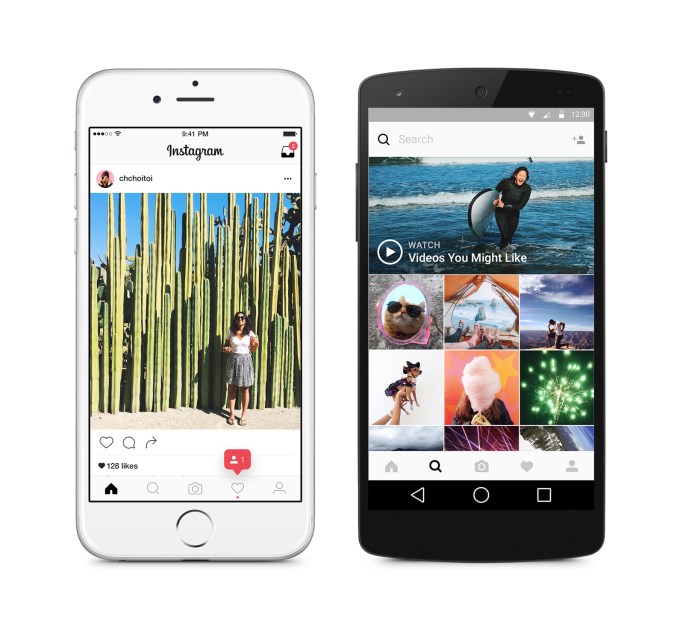
Instagram_UI

WHAT IS INSTAGRAM AND HOW DID IT GET STARTED?

Instagram is a popular app available in the app stores for Apple and Android that allows users to share and view pictures and videos posted by their friends, celebrities, or even strangers with photos they're interested in and includes photo editing features. The app also allows users to share to other apps and sites such as Facebook and Twitter. The CEO of Instagram, Kevin Systrom, actually taught himself programming during evenings after his marketing job in order to learn how to program more simple apps. This has inspired others to learn programming through online programming how to websites. The company reports using many different programming languages on their site/app including Python.

WHAT KINDS OF ALGORITHMS ARE USED WITHIN THE APP?

One of the newer algorithms created by the Instagram team allow users to see photos they may find more important/ better at the top of their feed regardless of when they were posted. The algorithm uses three main categories to determine which post you're likely to care about the most in order to keep the users interested. These include timing (how recently the photos/videos were shared), engagement (the amount of likes and comments a post has), and previous likes of similar photos/videos. This is similar to the Netflix "picked for you" feature I discussed in a previous post.

HOW DOES THIS RELATE TO COMPUTER SCIENCE?

Similar to other apps, Instagram uses different programming languages in order to input data such as photos from the phone's memory, videos recorded directly through the app, text from the keyboard, and user touch on the phone screen. Algorithms are then performed in order to  complete actions such as posting the user's media to the site, commenting on other user's media, and determining which photos to display on the user's screen. Pictures, videos, and sound are then output onto the user's screen.  


Photos and information from:
https://en.wikipedia.org/wiki/Instagram
http://www.business2community.com/instagram/new-instagram-algorithm-work-01567944#E5FWuipoSBRCS98T.97
http://www.computerscience.org/resources/computer-programming-languages/
https://techcrunch.com/2016/06/03/instagrams-new-algorithm-that-puts-the-best-posts-first-goes-live-for-all/
http://thenextweb.com/2012/04/10/instagrams-ceo-had-no-formal-programming-training-hes-a-marketer-who-learned-to-code-by-night/

Thursday, October 20, 2016

Post 9. Better the iPhone?


WHAT IS THE GOOGLE PIXEL ?

Google Pixel is Google's brand new smartphone made to be better than both the new iPhone 7 and the new Samsung Galaxy S7, which have both had their share of problems. The company promises an enhanced artificially intelligent personal assistant, quick charging, amazing camera quality, and smart storage. 


WHAT'S THE DIFFERENCE BETWEEN THE PERSONAL ASSISTANT AND SIRI?

Similar to Siri on the iPhone and the Google and S Voice functions on Android devices, the Google Pixel contains the Google Assistant which gives top Google results as answers to your questions. However, it is also able to use your voice to control every aspect of your phone like downloading apps and changing the brightness of the screen, as well as reminds you to charge the phone and tells you every calendar entry in your google emails. You are also able to directly use all of Google's features using the Google Assistant, such as finding directions in Google Maps and searching your documents in Google Drive. Another exceptional feature of the phone is that there is no need to press any buttons to activate the Google Assistant feature. After learning your voice, the phone responds to your "wake up" code of "Okay, Google". The company claims you can talk to it as you would a friend, as it understands more natural language that other voice commands.


WHAT ELSE IS GREAT ABOUT THE GOOGLE PIXEL?

Google offers that this device can hold seven hours of battery, and can charge fully in just 15 minutes.  The camera capabilities are slightly better than the Galaxy S7 and the iPhone 7, as phone-creators come closer to create full-camera capabilities in mobile phones. Another amazing ability of the phone is the storage feature. When the phone's storage is full it automatically backs up the photos and videos to Google Photos and deletes the older photos and videos in order to make space.

HOW DOES THIS RELATE TO COMPUTER SCIENCE?

Like other Artificial Intelligence devices, the Google Pixel's Assistant uses voice activated user-input, runs algorithms to change the speech into text and the text into action, and outputs whatever the user asks for out loud in speech form.  The phone is also programmed to automatically download the photos onto Google Photo when they reach a certain limit in order to conserve memory space, and uses the same algorithms as the Google site to answer questions. 


Photos and info: 
http://www.nbcnews.com/tech/tech-news/google-s-new-pixel-smartphone-has-some-features-you-will-n667906

http://www.forbes.com/sites/jaymcgregor/2016/10/20/googles-pixel-xl-has-one-game-changing-feature/#4dd8ab462391


Friday, October 14, 2016

Post 8. Computers Learning Creativity?

523_Robots

HOW CAN COMPUTERS BE CREATIVE?

Computer scientists and programmers, along with artists and and psychologists have been working to simulate human-level creativity using a computer. This is known as computational creativity. The goal is to have computers that can work alongside artists to produce poetry, music, visual arts, and other works of creativity. 

WHAT ARE SOME EXAMPLES OF THIS?

IBM recently used its supercomputer, Watson, to create a trailer for the new sci-fi/horror film entitled Morgan. This was the first trailer to be created entirely by artificial intelligence. In order to create the trailer, Watson analyzed the film in order to identify key moments of plot action, and was fed a hundred horror film trailers in order to create a similar trailer. (The trailer is shown below!) The trailer created by Watson did succeed in matching similarity to other horror/sci-fi trailers, however, there is not a clear understanding of the story-line, and it's not as sophisticated other human-made clips. Google researchers are also hoping to find whether artificial intelligence can be trained to create music and Microsoft has been working on creating artificial intelligence that can create paintings and other artwork. 


IS THIS REALLY ART?

Although no computers have been able to create these works without some human assistance, there has already been controversy as to whether works produced by computers can really be considered art. This is due to the belief that art should be a solely human experience, and that scientists are attempting to make art into a series of algorithms. 

HOW DOES THIS RELATE TO COMPUTER SCIENCE?

The computers that have been used to create works of art have been programmed with background information on similar works created by humans, and use algorithms to determine the best next step for the artwork. 


Information and pictures from:
http://phys.org/news/2016-09-supercomputer-world-ai-created-trailer.html
http://www.newsweek.com/can-artificially-intelligent-computer-make-art-462847
https://en.wikipedia.org/wiki/Computational_creativity

Wednesday, October 5, 2016

Post 7. Supporting Your Binge-Watching Addiction- How Netflix Works


Image result for netflix


NETFLIX?

Netflix (specifically the online site) is a video-on-demand streaming website with around 83 million users worldwide.

HOW DOES IT WORK?

The Netflix website displays all of the movies and TV shows in their database currently available to stream. The website database also stores information about each of the titles so that users are able to determine the genre, plot, actors, etc. of each of the thousands of titles available at a given time. Users are also able to browse by category, or use the search bar to display all of the titles related to one actor, director, or to display a specific title they are interested in. One of the most impressive features on the Netflix website is the ever-changing (and improving) recommendation service. Through this feature, the website is able to list all of the titles a user has viewed, and find the different correlations (all the same actress, same genre, same rating) in order to determine other titles the user may enjoy. Some of my own personal recommendation lists are shown below. 

save image


HOW DOES THIS RELATE TO COMPUTER SCIENCE?

The recommendation service on the website uses a complex algorithm in order to determine which titles a user may like. Basically, the website's system takes user input, runs the algorithm for determining their preferences, and outputs the thumbnails and descriptions of titles the user may enjoy. Specifically, the algorithm first used by the Netflix company was called CineMax. "According to Netflix, these predictions were accurate within half a star [of user rating] 75 percent of the time, and half of Netflix users who rented CineMatch-recommended movies gave them a five-star rating." In 2006, however, Netflix created a contest for algorithm developers and computer programmers to create an algorithm that was even more accurate at determining the likes of each of the 83 million users. The newly-developed algorithm had a 10 percent improvement over the original, and automatically updates the recommendation system constantly (as the user rates new titles) in order to create the best binge-watching experience. 


Photos and information from:
https://chrome.google.com/webstore/detail/netflix/deceagebecbceejblnlcjooeohmmeldh
http://electronics.howstuffworks.com/netflix2.htm
http://www.techradar.com/news/television/how-netflix-works-400-billion-interactions-per-day-ain-t-easy-1306420
https://en.wikipedia.org/wiki/Netflix
Netflix.com